How Aethyl works
You send a photo or video. Five AI models look at it, and their votes become one verdict. Here’s what happens in between, and where it can go wrong.
What you can check
Upload a photo or video from your phone, or send a post from TikTok, Instagram, X, YouTube or Reddit: tap Share, then Aethyl, or paste the link. If someone has already checked the same post, you get that result right away, without using your checking time.
Five AI models look at it
Gemini, Claude, ChatGPT, Grok and Muse each check it on their own. Gemini and Muse watch the video, and Gemini hears the sound too. Claude and ChatGPT look at frames from across the video, about one a second. On X, Grok opens the post itself; elsewhere it looks at frames too.
For a post, the models also read the caption and who posted it, because creators often say when something is AI.
Anything that wasn’t filmed with a camera counts as not real: AI video, but also CGI, animation and video game footage. So a cartoon or a game clip scores high too.
Their votes become one verdict
Each model gives a score from 0 to 100% AI. We combine them into one score, giving more weight to the models that have been most reliable in our tests. The score sets the verdict:
- Likely AI 75% and up
- Possibly AI 50 to 74%
- Uncertain 30 to 49%
- Likely real under 30%
Likely real means the models found no signs of AI. It doesn’t prove a video is real.
You see why
You don’t just get a number. You see each model’s score and what it found, in plain words. For a video, a timeline shows each model’s score across the clip, so you can see the moment it starts to look off. That helps with clips that are only partly AI.
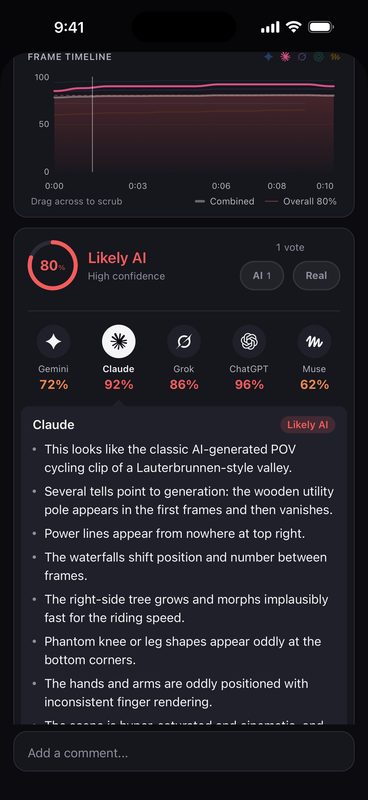
On posts, people can also vote AI or Real and talk it through. You can vote on your own upload too, and so can anyone you share its link with. Votes show next to the verdict and don’t change it.
Where it can be wrong
No AI detector is perfect, ours included. A verdict is a strong signal, not proof, and it can be wrong either way. These trip it up most:
- Real clips that look unreal: unusual animals, security camera footage, strange lighting, or anything that seems too wild to be true.
- Re-uploads: a clip that’s been downloaded, squeezed and posted again picks up smears and ghosting that look like AI glitches.
- Filters and edits: beauty filters, effects and AI sharpening change real faces and scenes.
- Clean AI: the best AI video has no visible flaws, so it can pass as real. That’s why Likely real isn’t proof.
- Clips that are only partly AI: a real video with an AI-made part. Check the timeline.
- New generators the models haven’t seen much of yet.
If a result looks wrong, read what each model found and check the timeline. Our guide on how to tell if a video is AI has checks you can do yourself. And tell us with the report button on the scan page: we use those reports to improve.
Your privacy
Photos and videos you upload stay private: nobody else can see one, or its result, unless you share its link. You can delete an upload at any time.
Everything you check is sent to third-party AI services to be analyzed, and may be used to train AI models. We don’t sell your personal data, and there are no ads. The Privacy Policy has the details.
Check the next video that makes you wonder.
Free on the App Store and Google Play.